
Table of Contents
A professionally designed website, high-quality content and a substantial digital marketing budget cannot deliver their full potential if search engines struggle to access, understand or index your website.
Technical SEO is the foundation of sustainable organic search performance. It ensures that website infrastructure, server configurations, page architecture, mobile usability, rendering capabilities and content delivery systems work together to support search engine accessibility and user experience.
As digital discovery evolves beyond traditional Google Search into AI-powered platforms such as ChatGPT, Google Gemini, Perplexity and Microsoft Copilot, businesses must also consider how automated information retrieval systems access and interpret their websites.
At Kamrio, our technical SEO services in Qatar combine advanced search engine optimization, website development, performance engineering, Semantic SEO, artificial intelligence search optimization and security-conscious digital marketing.
We help businesses across Doha, Lusail, Al Rayyan, Al Wakrah, Ras Laffan, Mesaieed and other areas of Qatar identify and resolve technical barriers that may restrict organic search visibility, website performance and business growth.
Our objective is to build technically reliable, accessible and scalable websites prepared for both traditional search engines and emerging AI-powered discovery environments.
What Are Technical SEO Services in Qatar?
Technical SEO services in Qatar are professional website optimization solutions focused on improving website crawlability, indexability, rendering, architecture, performance, mobile accessibility and machine-readable content.
Unlike traditional content optimization, technical SEO addresses the underlying infrastructure that allows search engines to discover, process and understand website information.
A comprehensive technical SEO strategy typically includes:
- Website crawling and indexing optimization.
- Robots.txt and XML sitemap management.
- Canonical tag and duplicate URL optimization.
- HTTP status code and redirect management.
- JavaScript SEO and rendering optimization.
- Core Web Vitals and website speed optimization.
- Mobile-first indexing optimization.
- Website architecture and internal linking.
- Structured data and Schema.org implementation.
- Multilingual SEO and hreflang configuration.
- AI crawler accessibility optimization.
- Website security and HTTPS evaluation.
- Technical monitoring and performance reporting.
Technical SEO does not independently guarantee first-page rankings. Instead, it establishes the technical conditions necessary for a website to compete effectively in organic search.
For a broader understanding of organic search strategies, explore our comprehensive guide to SEO services in Qatar.
Why Technical SEO Is Important for Businesses in Qatar
Qatar’s competitive digital marketplace requires businesses to maintain websites that are not only visually professional but also technically efficient, accessible and reliable.
Construction companies, industrial suppliers, engineering firms, hospitality businesses, healthcare providers, retailers and professional service organizations increasingly depend on websites to attract customers and generate commercial opportunities.
However, technical problems can remain invisible to business owners while significantly affecting search performance.
A website may appear functional to ordinary visitors while search engine crawlers encounter incorrect redirects, blocked resources, duplicate URLs, rendering failures or unintended indexing restrictions.
Improve Organic Search Accessibility
Search engines must be able to discover and process important website pages before those pages can compete for organic visibility.
Technical SEO removes unnecessary accessibility barriers and helps search engines identify commercially relevant content, including service pages, product categories, company information and educational resources.
Protect Your Digital Marketing Investment
Businesses often invest in content marketing, Google Ads, social media advertising and website development without evaluating their underlying technical infrastructure.
Publishing hundreds of optimized pages provides limited organic search value if those pages are accidentally excluded from indexing or inaccessible to search engines.
Technical SEO helps protect these investments by establishing a reliable digital foundation.
Improve Website User Experience
Slow loading times, broken navigation, unstable layouts and unresponsive website elements can negatively affect customer experience.
Technical optimization helps users access information efficiently, navigate between pages and complete important actions such as submitting enquiries, requesting quotations or purchasing products.
Support AI Search Visibility
AI-powered search platforms may retrieve information from websites, search indexes and other publicly available sources.
Technically accessible websites with clearly structured information can improve the conditions for automated content retrieval and interpretation.
However, no technical SEO implementation can guarantee that an AI platform will cite or recommend a particular business.
How Search Engines Crawl, Render, Index and Rank Websites
Understanding how search engines process websites is essential for identifying technical SEO problems.
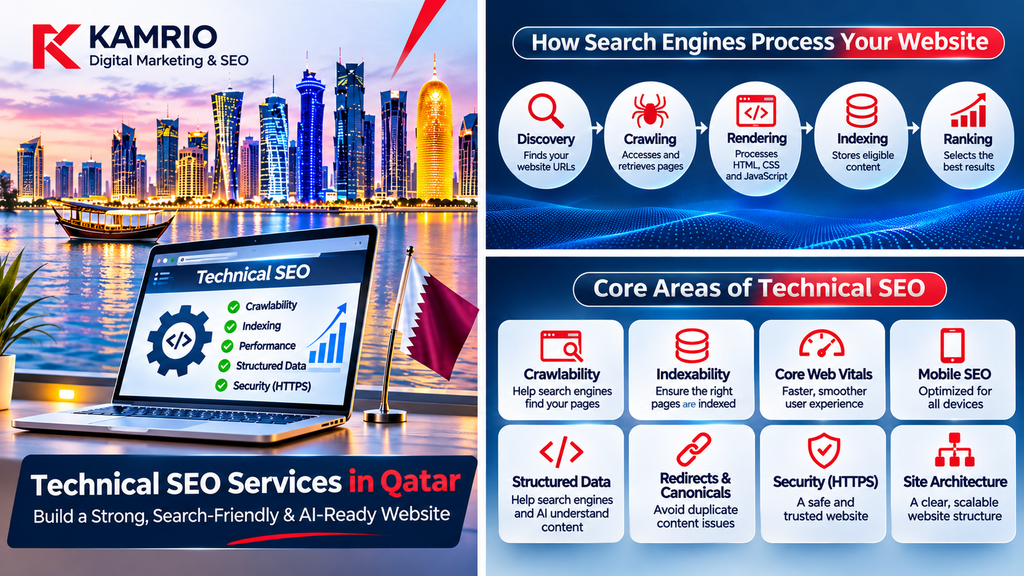
Search engine processing generally involves several interconnected stages.
| Stage | Technical function |
|---|---|
| Discovery | Identifying website URLs through links, sitemaps and other sources |
| Crawling | Retrieving website pages and accessible resources |
| Rendering | Processing HTML, CSS and supported JavaScript |
| Content processing | Interpreting text, links, metadata and canonical signals |
| Indexing | Evaluating and storing eligible website information |
| Ranking and retrieval | Selecting relevant information for search queries |
| Search presentation | Displaying organic results and eligible search features |
URL Discovery
Search engines discover website URLs through internal links, external references, XML sitemaps and previously known addresses.
Pages that are disconnected from the main website architecture may be more difficult to discover.
Website Crawling
Automated crawlers send HTTP requests to retrieve website content.
Server availability, robots.txt directives, HTTP status codes and crawl scheduling can influence whether a page is successfully accessed.
Website Rendering
Modern websites frequently use JavaScript to generate content and interactive functionality.
Search engines may need to render these pages before they can process important information.
Incorrect rendering configurations can prevent search engines from accessing essential content.
Website Indexing
After retrieving and processing a page, search engines evaluate whether it is suitable for inclusion in their indexes.
Not every crawled page will be indexed. Content quality, duplication, indexing directives and canonical signals can influence indexing decisions.
Search Ranking
Indexed information may be retrieved in response to relevant search queries.
Technical SEO supports this process, but ranking positions also depend on content relevance, competition, authority and other search signals.
What Is Included in Kamrio’s Technical SEO Services in Qatar?
Our technical SEO approach addresses the interconnected systems responsible for website accessibility, search performance, user experience and AI search readiness.
1. Website Crawlability Optimization
Website crawlability refers to the ability of automated search engine crawlers to discover and retrieve website pages.
Poor crawlability can prevent valuable business information from being accessed efficiently.
Our crawlability optimization approach includes reviewing:
- Robots.txt configurations.
- Internal navigation and crawlable links.
- Website URL structures.
- Broken internal links.
- Redirect chains and loops.
- Orphan pages.
- Blocked website resources.
- Server response errors.
- Unnecessary URL variations.
For large websites and e-commerce platforms, we also evaluate crawl efficiency to identify unnecessary crawling of duplicate, filtered or low-value URLs.
Crawl budget management is particularly relevant for large or frequently updated websites. Smaller business websites generally benefit more from resolving fundamental discovery and indexing problems.
2. Google Indexing and Indexability Optimization
A website page can be accessible to search engines without being included in their indexes.
Indexability optimization focuses on ensuring that important commercial pages are technically eligible for indexing.
Common indexing issues include:
| Indexing issue | Potential cause |
|---|---|
| Crawled – currently not indexed | Content quality, duplication or indexing decisions |
| Discovered – currently not indexed | Crawl scheduling, discovery or website quality issues |
| Excluded by noindex | Intentional or accidental indexing restriction |
| Blocked by robots.txt | Crawler access restriction |
| Duplicate without user-selected canonical | Inconsistent preferred URL signals |
| Soft 404 | Empty or error-like content returning a successful response |
| Server error | Hosting or application failure |
| Page with redirect | URL redirects to another destination |
Kamrio evaluates indexing information using Google Search Console, website crawling tools and technical diagnostics.
The objective is not to index every website URL. It is to ensure that valuable, unique and commercially relevant pages remain eligible for search visibility.
3. Robots.txt Optimization
The robots.txt file provides crawling instructions to compliant automated crawlers.
Incorrect configurations can prevent search engines from accessing important pages, images, stylesheets and JavaScript resources.
A professional robots.txt review evaluates whether crawler restrictions are intentional, whether essential resources remain accessible and whether sitemap references are correctly configured.
Businesses should understand that robots.txt is not a security mechanism. Confidential information must be protected through appropriate authentication and access controls.
4. XML Sitemap Optimization
An XML sitemap helps search engines discover website URLs that a business considers important.
A properly maintained sitemap should generally contain canonical, indexable URLs that return successful HTTP responses.
Redirected pages, broken URLs, duplicate noncanonical pages and unintended noindex pages should not routinely appear in XML sitemaps.
For large corporate websites, e-commerce stores and multilingual platforms, separate sitemaps may be appropriate for products, categories, services, articles and language-specific content.
XML sitemaps support URL discovery but do not guarantee indexing.
5. Canonical Tag and Duplicate Content Optimization
Duplicate content occurs when identical or substantially similar information is accessible through multiple website URLs.
Common causes include:
- HTTP and HTTPS variations.
- WWW and non-WWW domain versions.
- Tracking parameters.
- Product sorting and filtering.
- Duplicate category pages.
- CMS-generated archive pages.
- Trailing-slash variations.
- Repeated service page content.
Canonical tags help search engines identify preferred page versions.
However, canonical declarations are signals rather than absolute commands. Search engines may select different canonical URLs when other website signals conflict.
Our approach aligns canonical tags, internal links, redirects and XML sitemap entries to establish consistent preferred URL signals.
6. HTTP Status Code and Redirect Optimization
HTTP status codes communicate how a web server responds to requests.
Incorrect status codes can affect website accessibility, navigation and search engine processing.
| HTTP status code | Meaning | Technical SEO application |
|---|---|---|
| 200 | Successful response | Accessible and functioning pages |
| 301 | Permanent redirect | Permanent URL changes |
| 302 | Temporary redirect | Temporary URL changes |
| 308 | Permanent redirect | Permanent redirect preserving request method |
| 403 | Forbidden | Restricted access |
| 404 | Not found | Unavailable resources |
| 410 | Gone | Intentionally removed resources |
| 429 | Too many requests | Rate limiting |
| 500 | Internal server error | Application or server failure |
| 503 | Service unavailable | Temporary service interruption |
Kamrio evaluates redirect chains, redirect loops, broken links and incorrect HTTP responses to improve website navigation and technical consistency.
Redirect management is particularly important during website redesigns, domain changes and CMS migrations.
7. Website Architecture and Internal Linking
Website architecture determines how information is organized and connected throughout a website.
A logical architecture helps search engines discover important pages while allowing users to navigate efficiently between relevant topics.
An effective website structure may include:
- Homepage.
- Primary service categories.
- Individual commercial service pages.
- Industry-specific pages.
- Educational pillar content.
- Supporting topic clusters.
- Case studies and technical resources.
- Contact and conversion pages.
Internal links should establish meaningful relationships between related content using descriptive anchor text.
For businesses operating extensive product catalogs or multiple service categories, logical website architecture can reduce navigation complexity and improve information discovery.
Our Semantic SEO approach connects relevant topics and entities through structured website architecture rather than relying on excessive keyword repetition.
8. JavaScript SEO and Website Rendering Optimization
Modern websites frequently use JavaScript frameworks such as React, Angular, Vue.js and Next.js.
Although these technologies can create powerful digital experiences, implementation decisions may influence search engine accessibility.
Important website information should remain accessible to supported crawlers without unnecessary dependencies on user interactions or unreliable external resources.
| Rendering method | Technical function |
|---|---|
| Client-Side Rendering (CSR) | Generates page content through browser-side JavaScript |
| Server-Side Rendering (SSR) | Generates HTML on the server |
| Static Site Generation (SSG) | Generates HTML during the build process |
| Incremental Static Regeneration (ISR) | Updates prebuilt pages according to configured regeneration rules |
| Hybrid rendering | Combines different rendering approaches |
Common JavaScript SEO problems include inaccessible navigation links, delayed metadata generation, incorrect HTTP responses, empty initial HTML and content that only appears after user interaction.
Kamrio evaluates rendering behavior and website architecture to identify suitable technical improvements.
Where appropriate, delivering meaningful HTML in the initial server response can improve compatibility with a broader range of automated clients.
Core Web Vitals and Website Speed Optimization in Qatar
Website performance directly influences how efficiently customers can access information and interact with digital services.
For businesses in Qatar, performance optimization should consider mobile devices, hosting infrastructure, geographically relevant network latency and actual user behavior.
Google’s Core Web Vitals provide measurable indicators of real-world website experience.
| Core Web Vital | Measurement | Good threshold |
|---|---|---|
| Largest Contentful Paint (LCP) | Loading performance | 2.5 seconds or less |
| Interaction to Next Paint (INP) | Interaction responsiveness | 200 milliseconds or less |
| Cumulative Layout Shift (CLS) | Visual stability | 0.1 or less |
These thresholds are evaluated at the 75th percentile of relevant page visits when sufficient field data is available.
Largest Contentful Paint Optimization
Largest Contentful Paint measures the loading performance of the largest relevant visible content element.
LCP optimization may include improving server response times, optimizing hero images, prioritizing critical resources and reducing render-blocking CSS and JavaScript.
Interaction to Next Paint Optimization
Interaction to Next Paint measures website responsiveness during user interactions.
Heavy JavaScript execution, inefficient event handlers and excessive main-thread processing can negatively affect responsiveness.
Optimization may involve code splitting, reducing unnecessary third-party scripts and improving application execution efficiency.
Cumulative Layout Shift Optimization
Cumulative Layout Shift measures unexpected visual movement during website usage.
Common causes include images without defined dimensions, dynamically inserted content, unstable font rendering and late-loading website elements.
Defining appropriate image dimensions and reserving space for dynamic content can improve visual stability.
Additional Website Performance Optimization
Beyond Core Web Vitals, technical performance analysis may evaluate:
- Time to First Byte (TTFB).
- First Contentful Paint (FCP).
- Total Blocking Time (TBT).
- Server response times.
- Resource transfer sizes.
- Database performance.
- Browser caching.
- JavaScript execution.
- Network request efficiency.
Kamrio combines laboratory diagnostics with available real-world performance data to identify practical optimization opportunities.
A high performance score alone does not guarantee search rankings. Performance improvements should support accessibility, usability and commercial conversion objectives.
Server, Hosting and CDN Optimization for Qatar Businesses
Website hosting infrastructure plays an important role in website reliability, loading performance and crawler accessibility.
A website hosted on a powerful server may still experience performance problems due to inefficient application code, excessive database queries, poorly configured caching or network latency.
Server-Side Performance Optimization
Server-side optimization may include reviewing database efficiency, PHP execution, application caching, web server configuration and resource allocation.
The appropriate solution depends on the website’s technology, traffic levels and operational requirements.
Content Delivery Network Optimization
A Content Delivery Network (CDN) distributes eligible website resources through geographically distributed infrastructure.
CDNs can help reduce network latency and improve the delivery of images, CSS files, JavaScript resources and other static assets.
For Qatar-based businesses, CDN performance should be evaluated against the actual geographic distribution of their customers.
Browser Caching and Resource Compression
Browser caching allows eligible website resources to be reused instead of repeatedly downloaded.
Compression technologies such as Brotli and Gzip can reduce the transfer size of supported text-based resources.
A professional caching strategy must balance website performance with content freshness, functionality, privacy and security.
Mobile-First Indexing and Responsive Website Optimization
Google primarily uses the mobile version of website content for indexing.
Businesses must therefore ensure that important information remains accessible and consistent across desktop and mobile devices.
Mobile technical SEO includes responsive website architecture, readable typography, accessible navigation, optimized images, functional enquiry forms and consistent structured data.
Important commercial content should not be removed from mobile versions simply to create a visually cleaner layout.
For businesses in Qatar, mobile accessibility is particularly important because customers may discover companies through Google Search, Google Maps, social media and WhatsApp.
Kamrio’s website design and development services incorporate responsive design, technical accessibility and performance considerations into website development.
Structured Data and Schema Markup Optimization
Structured data provides standardized, machine-readable descriptions of website information.
Using Schema.org vocabulary, businesses can describe their identity, services, products, articles, locations and other relevant entities.
| Schema type | Recommended application |
|---|---|
| Organization | Company identity and business information |
| LocalBusiness | Eligible physical business locations |
| Service | Commercial service information |
| Product | Individual product information |
| BlogPosting | Educational articles and blog content |
| BreadcrumbList | Website navigation hierarchy |
| Person | Genuine author and professional profiles |
| FAQPage | Visible frequently asked questions |
| VideoObject | Eligible video content |
JSON-LD is a commonly recommended format for implementing Google-supported structured data.
A professional structured data strategy should ensure that markup accurately represents visible website content.
Fabricated reviews, unsupported ratings, misleading business information and inaccurate product details should never be included.
Structured data can support machine-readable content interpretation and eligibility for certain search features. It does not guarantee rich results, higher rankings or AI citations.
Technical SEO for AI Search Visibility, AEO, GEO, AIO and LLM Optimization
The development of AI-powered search systems is expanding the ways customers discover business information.
Instead of relying exclusively on conventional search results, users may ask conversational platforms to compare suppliers, explain technical services or recommend potential business solutions.
Technical SEO supports these discovery environments by improving website accessibility, information architecture and machine-readable content.
Technical SEO for Answer Engine Optimization (AEO)
Answer Engine Optimization focuses on providing clear and accurate answers to user questions.
From a technical perspective, AEO benefits from accessible HTML content, meaningful heading structures, well-organized information, descriptive internal links and consistent website metadata.
Important answers should be available within accessible page content rather than hidden behind unnecessary interactive functionality.
Technical SEO for Generative Engine Optimization (GEO)
Generative Engine Optimization focuses on improving the conditions under which content may be discovered, interpreted and referenced by generative search systems.
Technical GEO considerations include crawler accessibility, clear website architecture, canonical consistency, accessible supporting references and well-structured original content.
The objective is to make credible information easier to retrieve and interpret.
Technical SEO for Large Language Model Optimization (LLMO)
Large Language Model Optimization focuses on improving the clarity and consistency of publicly available business information within language model-based discovery environments.
Technical LLM optimization may include consistent company information, semantic HTML, accessible service descriptions, structured entity relationships and appropriate crawler policies.
These practices do not directly control language model training or guarantee brand recommendations.
Technical SEO for AI Optimization (AIO)
AI Optimization combines conventional search accessibility with technical and content practices that support emerging AI-assisted discovery experiences.
It incorporates website accessibility, information consistency, structured data, Semantic SEO and content quality into an integrated digital visibility strategy.
AI Crawler Accessibility and Robots.txt Management
Different automated crawlers serve different purposes.
| Crawler | General purpose |
|---|---|
| Googlebot | Google Search crawling |
| Bingbot | Microsoft Bing crawling |
| OAI-SearchBot | OpenAI search-related discovery |
| GPTBot | Potential collection for OpenAI model training |
| ChatGPT-User | Certain user-initiated website requests |
Search discovery and model-training access are separate considerations.
Businesses should establish crawler policies according to their content distribution preferences, intellectual property considerations and commercial objectives.
Crawler configurations should be reviewed against the latest official platform documentation before implementation.
Semantic HTML and Machine-Readable Content
Semantic HTML helps establish meaningful relationships between different sections of website information.
Proper use of headings, articles, sections, navigation elements, tables and descriptive links supports accessibility and clearer content organization.
Businesses should prioritize meaningful HTML content rather than relying exclusively on images, inaccessible scripts or decorative visual elements to communicate essential information.
Does an llms.txt File Improve AI Search Visibility?
An llms.txt file is a proposed convention for presenting selected website information in a format intended to be convenient for language model-based systems.
It is not an established universal search ranking requirement.
Businesses may experiment with llms.txt, but it should not replace accessible HTML, XML sitemaps, appropriate robots.txt configurations, structured data or conventional technical SEO.
There is no guaranteed AI ranking or citation benefit from implementing an llms.txt file.
Technical SEO for English and Arabic Websites in Qatar
Qatar’s multilingual business environment creates opportunities for companies to reach both English-speaking and Arabic-speaking customers.
However, multilingual website optimization requires more than translating content.
A technically reliable bilingual website should consider:
- Separate language-specific URLs.
- Appropriate hreflang annotations.
- Language-specific metadata.
- Consistent canonical tags.
- Correct character encoding.
- Arabic right-to-left website layouts.
- Accessible language navigation.
- Localized structured data where appropriate.
- Language-specific sitemap management where necessary.
Hreflang annotations help supported search engines understand relationships between equivalent language or regional page versions.
English and Arabic pages should provide genuine localized value rather than relying exclusively on automated translation.
Proper multilingual architecture supports website accessibility, customer experience and geographically relevant search visibility.
Technical SEO and Website Cybersecurity
Website security and technical SEO are closely connected.
A compromised website may contain unauthorized redirects, injected spam pages, malicious scripts, altered canonical tags or unexpected indexing directives.
These problems can disrupt business operations, damage customer confidence and affect organic search visibility.
| Website security issue | Potential SEO impact |
|---|---|
| Expired SSL certificate | Browser warnings and accessibility problems |
| Injected spam pages | Unwanted search indexing |
| Malicious redirects | Visitors redirected to unauthorized destinations |
| Compromised robots.txt | Important pages blocked from crawling |
| Unauthorized canonical changes | Incorrect preferred URL signals |
| Outdated plugins or themes | Increased vulnerability exposure |
| Server compromise | Downtime and content integrity problems |
Kamrio’s security-conscious technical SEO approach considers HTTPS configuration, website integrity, suspicious URL changes and unexpected search engine directives.
Technical SEO security reviews complement website security management but do not replace comprehensive cybersecurity assessments or penetration testing.
Businesses in Qatar should also consider applicable obligations under Qatar’s Personal Data Privacy Protection Law, Law No. 13 of 2016, when implementing analytics, tracking systems and customer information collection processes.
AI-Driven Growth. Data-Secure Marketing. Real Results.
Technical SEO Services for Different Website Platforms
Different website technologies require different technical optimization strategies.
Kamrio’s website development and SEO approach considers the underlying architecture of each platform.
WordPress Technical SEO Services
WordPress technical SEO focuses on theme performance, plugin configurations, website caching, database efficiency, duplicate archive pages, canonical tags and indexing management.
Businesses should pay particular attention to conflicting SEO plugins, unnecessary taxonomy pages and excessive third-party scripts.
Shopify Technical SEO Services
Shopify technical SEO involves product URL consistency, collection architecture, duplicate product variations, structured data, theme performance and application-generated resources.
Platform-specific URL conventions and technical limitations must be considered before implementing changes.
WooCommerce Technical SEO Services
WooCommerce websites may require optimization of product filtering, category architecture, database performance, product structured data and checkout-related resource loading.
Large WooCommerce stores should also evaluate unnecessary URL generation and crawl efficiency.
React and Next.js Technical SEO Services
JavaScript-based websites require careful evaluation of rendering strategies, metadata delivery, dynamic routing, HTTP responses and content accessibility.
Selecting suitable rendering methods can help balance website performance, functionality and search engine compatibility.
Laravel and Custom Website Technical SEO
Custom web applications may require direct implementation of metadata generation, canonical tags, sitemap management, routing, caching and HTTP status codes.
Unlike conventional content management systems, many SEO-related features must be developed within the application architecture.
| Website platform | Technical SEO priorities |
|---|---|
| WordPress | Plugins, caching, archives and metadata |
| Shopify | Product URLs, collections and theme performance |
| WooCommerce | Product architecture, filtering and database efficiency |
| React | Rendering and content accessibility |
| Next.js | Rendering strategy, metadata and caching |
| Laravel | Routing, HTTP responses and dynamic metadata |
| Webflow | Page architecture, redirects and localization |
| Wix | Platform-specific indexing and performance settings |
Technical SEO for Different Industries in Qatar
Every industry has different website requirements, commercial objectives and technical challenges.
A technical SEO strategy should reflect the organization’s actual business operations.
Construction and Contracting Companies
Construction companies require accessible service pages, project portfolios, technical capabilities, company credentials and RFQ submission forms.
Technical optimization helps organize these resources and make important commercial information easier to discover.
Industrial and Oil & Gas Companies
Industrial suppliers and oil and gas service providers often maintain extensive product catalogs, technical documentation and engineering resources.
Technical SEO helps manage product architecture, downloadable documents, indexing configurations and website performance.
E-commerce Businesses
E-commerce websites require particular attention to duplicate product URLs, faceted navigation, category architecture, product structured data and mobile performance.
Technical optimization should preserve customer navigation while reducing unnecessary URL duplication.
Hospitality and Tourism Businesses
Hospitality websites require reliable mobile experiences, accessible location information, optimized visual resources and functional reservation systems.
Website performance and accessibility are particularly important for customers researching services on mobile devices.
Corporate and Professional Service Businesses
Corporate websites benefit from logical service architecture, accessible company information, consistent metadata, reliable enquiry forms and clear internal navigation.
Kamrio develops technical optimization recommendations according to website complexity, business requirements and customer expectations.
Technical SEO for Website Redesigns and Migrations
Website redesigns, domain changes and platform migrations can create significant organic search risks when implemented without technical SEO planning.
Common migration problems include lost URLs, incorrect redirects, missing metadata, changed canonical tags, broken internal links and accidental indexing restrictions.
A professional website migration strategy should include:
- Recording existing website URLs and search performance.
- Identifying important commercial pages.
- Preparing an old-to-new URL redirect map.
- Preserving relevant content and metadata.
- Testing the new website before launch.
- Reviewing robots.txt and indexing directives.
- Validating redirects and canonical tags.
- Updating XML sitemaps.
- Monitoring Google Search Console after launch.
- Investigating unexpected indexing or traffic changes.
Technical SEO should be integrated into website development from the beginning rather than introduced only after search visibility problems appear.
Kamrio’s Technical SEO Audit and Implementation Process
Our technical SEO methodology follows a structured approach that connects website diagnostics, prioritized implementation and ongoing performance monitoring.
Phase 1: Website Infrastructure Assessment
We begin by understanding the website’s technology, hosting environment, architecture, business objectives and existing technical configurations.
This establishes the context required for meaningful technical analysis.
Phase 2: Comprehensive Website Crawl
Website crawling helps identify broken links, redirect chains, duplicate URLs, orphan pages, metadata inconsistencies and accessibility problems.
Findings are evaluated according to their relevance and potential business impact.
Phase 3: Indexing and Search Performance Analysis
Available Google Search Console information is reviewed to understand indexing patterns, canonical selection, search visibility and website accessibility.
Phase 4: Website Performance and Rendering Analysis
We evaluate Core Web Vitals, server responses, JavaScript rendering, mobile accessibility and resource delivery to identify performance improvement opportunities.
Phase 5: Structured Data and AI Search Readiness
Website markup, semantic information architecture, crawler policies and entity consistency are reviewed as part of technical search readiness.
Phase 6: Technical Remediation and Implementation
Identified problems are prioritized according to severity, affected pages, implementation complexity and commercial importance.
Technical changes should be supported by appropriate backups, testing and change management.
Phase 7: Validation and Continuous Monitoring
After implementation, affected pages are reviewed to verify technical changes.
Ongoing monitoring helps identify new issues introduced through website updates, content changes, platform upgrades or infrastructure modifications.
Technical SEO Tools and Technologies
Professional technical SEO requires reliable evidence from multiple diagnostic sources.
| SEO tool | Primary application |
|---|---|
| Google Search Console | Indexing and organic search diagnostics |
| Screaming Frog SEO Spider | Website crawling and technical analysis |
| Google Lighthouse | Laboratory performance testing |
| PageSpeed Insights | Performance analysis and available field data |
| Chrome DevTools | Network, rendering and JavaScript diagnostics |
| Bing Webmaster Tools | Bing indexing and search diagnostics |
| Google Rich Results Test | Supported structured data validation |
| Schema Markup Validator | Schema.org markup validation |
| Ahrefs | Website auditing and backlink analysis |
| Semrush | Technical auditing and competitive analysis |
| WebPageTest | Detailed website performance investigation |
| Server access logs | Analysis of actual HTTP requests |
Automated SEO tools provide valuable diagnostic information, but their findings require professional interpretation.
Not every reported warning represents a critical technical problem. Some findings may reflect intentional configurations or platform-specific limitations.
Technical SEO Issue Prioritization
An effective technical SEO strategy prioritizes problems according to their potential impact rather than attempting to resolve every warning simultaneously.
| Priority | Example technical issue |
|---|---|
| Critical | Production website accidentally blocked from crawling |
| Critical | Important service pages returning server errors |
| Critical | Unauthorized redirects or injected spam |
| High | Important pages excluded by unintended noindex directives |
| High | Incorrect canonical tags across commercial pages |
| High | Important content unavailable during rendering |
| Medium | Poor Core Web Vitals across important templates |
| Medium | Excessive redirect chains |
| Medium | Duplicate product or category URLs |
| Low | Minor metadata inconsistencies |
Priority levels should be adjusted according to actual website conditions and commercial importance.
How to Measure Technical SEO Performance
Technical SEO performance should be evaluated using measurable improvements in website accessibility, infrastructure reliability and search readiness.
Important technical SEO KPIs include:
| KPI | Measurement objective |
|---|---|
| Important indexable URLs | Maintain eligibility of commercially relevant pages |
| Server error frequency | Monitor website reliability |
| Broken internal links | Improve navigation and accessibility |
| Redirect chain frequency | Reduce unnecessary requests |
| Canonical consistency | Maintain preferred URL signals |
| Core Web Vitals pass rate | Improve real-world website experience |
| Structured data validity | Reduce markup errors |
| Orphan page count | Improve website connectivity |
| Mobile content consistency | Maintain access to essential information |
| Crawler accessibility | Verify intended automated access |
| Organic conversions | Evaluate associated commercial outcomes |
Technical improvements should be documented through baseline measurements and post-implementation comparisons.
Changes in organic traffic, rankings and conversions should also consider content improvements, competition, seasonality and other factors.
Technical SEO Checklist for Businesses in Qatar
Business owners, website administrators and marketing teams can use the following checklist as a preliminary technical website assessment.
Crawling and Indexing
- Important website pages return HTTP 200 responses.
- Robots.txt does not unintentionally block important content.
- Commercial pages do not contain accidental noindex directives.
- XML sitemaps contain preferred, eligible URLs.
- Canonical tags are correctly configured.
- Important pages are connected through internal links.
Website Performance and Rendering
- Core Web Vitals are monitored.
- Important content is accessible during rendering.
- Images and critical website resources are optimized.
- Unnecessary JavaScript execution is minimized.
- Server response times are evaluated.
- Mobile and desktop versions contain consistent essential information.
Website Architecture and Localization
- Internal navigation is crawlable.
- Broken links and unnecessary redirects are resolved.
- Website URL structures are consistent.
- Hreflang annotations are valid where applicable.
- Arabic website layouts support right-to-left functionality.
AI Search and Website Security
- Structured data accurately represents visible content.
- AI crawler policies reflect business requirements.
- Company and service information is consistent.
- HTTPS configuration is valid.
- Unexpected website changes are monitored.
- Customer information is handled responsibly.
This checklist provides an initial assessment framework. A comprehensive technical SEO audit should investigate website-specific conditions in greater detail.
How Much Do Technical SEO Services Cost in Qatar?
Technical SEO pricing in Qatar depends on website size, platform complexity, existing technical problems, implementation requirements and ongoing monitoring needs.
A small corporate website generally requires a different technical investment from an enterprise platform or e-commerce store containing thousands of URLs.
| Technical SEO service | Typical scope |
|---|---|
| Initial technical assessment | Identification of major website accessibility problems |
| Comprehensive technical SEO audit | Detailed infrastructure, indexing and performance analysis |
| Technical SEO implementation | Resolution of prioritized technical issues |
| E-commerce technical SEO | Product architecture, filtering and duplicate URL management |
| Website migration SEO | Redirect planning and migration validation |
| Enterprise technical SEO | Large-scale infrastructure and technical governance |
| Ongoing technical SEO | Continuous monitoring and optimization |
Businesses should request a customized quotation that clearly distinguishes audit activities, implementation work and ongoing technical maintenance.
At Kamrio, technical SEO recommendations are developed according to the website’s actual condition, technology and commercial objectives.
How Long Does Technical SEO Take to Show Results?
Technical SEO implementation may take several days, weeks or months depending on website complexity, issue severity and development requirements.
| Implementation stage | Illustrative timeframe |
|---|---|
| Initial technical assessment | 1–2 weeks |
| Critical issue remediation | 1–4 weeks |
| Architecture and performance optimization | 1–3 months |
| Advanced technical implementation | 2–6 months or longer |
| Technical monitoring | Ongoing |
Some improvements, such as correcting broken links or removing accidental indexing restrictions, may be implemented relatively quickly.
More complex improvements involving website architecture, JavaScript rendering, hosting infrastructure or large-scale migrations may require additional development and testing.
Search engines may also require additional time to crawl and process updated website information.
These timeframes are illustrative and should not be interpreted as guaranteed ranking or indexing schedules.
Why Choose Kamrio for Technical SEO Services in Qatar?
Technical SEO requires more than operating an automated website auditing tool. It requires an understanding of search engines, website development, application architecture, performance engineering and commercial objectives.
Kamrio combines these disciplines through an integrated digital growth methodology.
Advanced Technical SEO Expertise
Our approach addresses crawling, indexing, rendering, website architecture, structured data and technical performance rather than focusing exclusively on keyword rankings.
Website Development Capabilities
Our website development knowledge supports the identification and resolution of technical problems across content management systems, e-commerce platforms and modern web applications.
AI Search Optimization
We incorporate AEO, GEO, AIO, LLM optimization and Semantic SEO principles into our broader technical search readiness methodology.
Qatar-Focused Optimization
Our strategies consider Qatar’s multilingual audiences, local commercial requirements, mobile accessibility and geographically relevant website performance.
Security-Conscious Digital Marketing
We recognize the importance of website integrity, responsible administrative access, secure infrastructure and client data confidentiality.
Data-Driven Technical Decisions
Our technical recommendations are based on documented findings, diagnostic evidence, implementation priorities and measurable performance indicators.
Sustainable Search Optimization
Kamrio prioritizes long-term website reliability and ethical optimization practices rather than misleading ranking guarantees or artificial search manipulation.
Frequently Asked Questions About Technical SEO Services in Qatar
What are technical SEO services in Qatar?
Technical SEO services in Qatar are professional website optimization solutions focused on improving crawlability, indexability, rendering, website architecture, performance, structured data and technical search accessibility.
What is the difference between technical SEO and on-page SEO?
Technical SEO focuses on website infrastructure and search engine accessibility. On-page SEO primarily focuses on individual page content, relevance, headings, metadata and search intent. Both disciplines work together to support organic search performance.
Why is my website not indexed by Google?
Possible reasons include noindex directives, crawler restrictions, duplicate content, server errors, canonicalization problems, insufficient content value or Google not yet selecting the page for indexing. A technical assessment can help identify likely causes.
Can technical SEO improve Google rankings?
Technical SEO can remove accessibility, indexing and performance barriers that may limit organic search visibility. However, rankings also depend on content quality, relevance, competition and other search signals.
What are Core Web Vitals?
Core Web Vitals are Google’s user experience metrics covering loading performance, interaction responsiveness and visual stability through Largest Contentful Paint, Interaction to Next Paint and Cumulative Layout Shift.
Does technical SEO help websites appear in AI search results?
Technical SEO can improve website accessibility and content retrieval conditions for eligible AI-powered systems. It does not guarantee that a website will be cited or recommended by an AI platform.
Is technical SEO necessary for WordPress websites?
Yes. WordPress websites can experience technical issues involving plugins, themes, duplicate archives, caching, metadata, indexing directives and website performance.
Can JavaScript affect website SEO?
Yes. JavaScript implementation can affect content accessibility, rendering, navigation, metadata delivery and website performance. Proper rendering strategies and technical testing help reduce these risks.
Is structured data important for technical SEO?
Structured data helps supported systems understand website content and entity relationships. It can support eligibility for certain search features but does not guarantee higher rankings.
How often should a technical SEO audit be performed?
Technical SEO should be monitored continuously where practical. Comprehensive audits can be scheduled quarterly or according to website complexity, with additional reviews after migrations, redesigns and major platform updates.
Can website security problems affect SEO?
Yes. Website compromises can introduce spam pages, malicious redirects, unexpected indexing changes and downtime. These issues can damage website credibility and organic search visibility.
Does Kamrio provide technical SEO for e-commerce websites?
Kamrio provides SEO and website development solutions that can address e-commerce technical requirements, including product architecture, duplicate URLs, structured data and website performance.
How long does technical SEO implementation take?
Implementation may take several days, weeks or months depending on website complexity, the number of issues, developer availability and required testing. Search engines may require additional time to process changes.
Does an llms.txt file improve AI search rankings?
There is no established guarantee that llms.txt improves AI search rankings or citations. Businesses should prioritize accessible HTML, accurate content, technical SEO and appropriate crawler configurations.
How much does a technical SEO audit cost in Qatar?
The cost depends on website size, platform, technical complexity and audit scope. Businesses should request a customized quotation based on their actual website requirements.
Build a Technically Strong Website for the Future of Search
Technical SEO is the foundation of sustainable organic search visibility, website accessibility and digital performance.
As search evolves across Google, Bing and AI-powered information retrieval platforms, businesses must ensure that their websites remain technically accessible, reliable and understandable.
A comprehensive technical SEO strategy should address website crawling, indexing, JavaScript rendering, canonicalization, website architecture, Core Web Vitals, structured data, multilingual accessibility and security-conscious infrastructure management.
At Kamrio, our technical SEO services in Qatar combine advanced search optimization, website development, performance engineering, Semantic SEO and AI search readiness to support long-term digital growth.
Whether your business operates a corporate website, an e-commerce platform, a multilingual website or a custom web application, a technically reliable foundation is essential for competing in an increasingly connected digital environment.
Request a Professional Technical SEO Audit in Qatar
Is your website technically prepared for Google Search and AI-powered discovery?
Are indexing problems, slow loading speeds, rendering errors or inefficient website architecture limiting your digital growth?
Kamrio can help identify technical barriers and develop a prioritized optimization strategy based on your website’s requirements.
Contact us today to discuss your technical SEO requirements and discover opportunities to improve your website’s search accessibility, performance and digital visibility.
Kamrio – Digital Marketing & SEO Agency
AI-Driven Growth. Data-Secure Marketing. Real Results.
Location: Doha, Qatar
Phone: +974 6624 6371
Email: info@kamrio.com
Website: www.kamrio.com
Request Your Technical SEO Audit Today